
Table of Contents
Why the Right Toolholder Changes Everything
In modern machining, the toolholder is the smallest component with the biggest leverage over your results. A few microns of runout or a touch of unbalance can erase the benefits of premium carbide and advanced toolpaths. Push rpm, reach deeper, or cut thinner walls and you’ll discover that stability at the spindle nose decides whether a cycle feels like a controlled glide or a noisy wrestling match.
Common pains Jeil solves:
Runout that wrecks tool life: Uneven chip load from 8–10 µm TIR sends one flute into thermal overload while the others idle, shortening life and degrading tolerance.
Slow, inconsistent changeovers: Friction-heavy nuts, worn collets, and fussy setups add hidden minutes and variation to every shift.
Chatter, burrs, and rework: Thin walls and long overhangs amplify micro-instability into visible chatter marks and time-consuming deburring.
Value you’ll measure:
Precision: ≤3 µm TIR at the nose translates to uniform chip load, cleaner walls, and predictable sizing.
Rigidity & damping: Optimized wall thickness, wedge geometry, and hydraulic damping (on applicable series) attack vibration at the source.
Tool life & finish: Reduced micro-vibration preserves edge integrity—especially in Ti/HRSA—while improving Ra on finishing passes.
Lower COC (Cost of Cut): Fewer tool changes, faster feeds, less rework. The math compounds over every spindle hour.
Jeil Family Overview
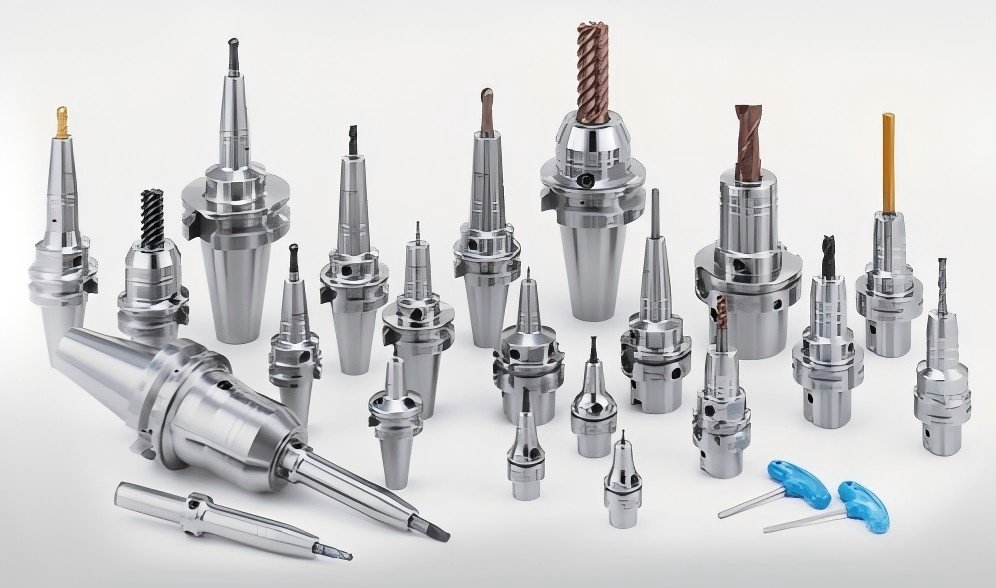
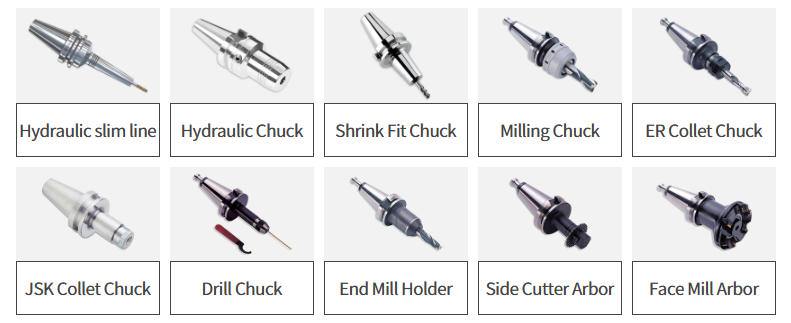
Choose the series that matches your spindle, speed, and cut strategy. If you don’t see a configuration, ask—custom balancing, slim noses, and special gauge lengths are available.
Series Matrix
Series | Interfaces (BT/HSK/NT/ER/Straight) | Clamping Range | Balance Grade | Coolant (OD/ID) | Typical Applications | Matching Tool Types |
J-ER Collet Chuck | BT30/40/50, HSK-A40/50/63/100, ER nut | ER16–ER40 (Ø1–26 mm) | G6.3 @ 12k (opt. G2.5) | OD & ID | General milling, drilling, reaming | Solid carbide EM, drills, reamers |
J-MC Milling Chuck | BT40/50, HSK-A63/100 | Ø6–25 mm | G2.5 @ 25k | OD & ID | Heavy roughing, slotting, interrupted cuts | Solid EM, roughers, indexables |
J-HC Hydraulic Chuck | BT30/40/50, HSK-A50/63 | Ø3–20 mm | G2.5 @ 25k | ID (sealed options) | Finishing, thin-wall parts, long reach | Ball/torus EM, finish EM |
J-WE Weldon Holder | BT40/50, HSK-A63 | Ø6–25 mm (Weldon) | G6.3 @ 12k | OD | High-torque slotting, pullout control | Weldon-shank EM |
J-SMA Shell Mill Arbor | BT40/50, HSK-A63/100 | Ø22–40 mm pilot | G6.3 @ 12k | OD | Face milling, high MRR | Shell/face mills |
J-SF Shrink-Fit | HSK-A50/63, BT30/40 | Ø3–20 mm | G2.5 @ 25k | ID | High-speed finishing, micro-TIR | Solid carbide EM/drills |
J-EXT Straight Extension | Straight shank, ER | Ø6–20 mm | G6.3 @ 12k | OD | Deep cavity access, molds | Slim EM, long-neck tools |
Jeilsolution toolholder-VOL.1
Technical Highlights That Drive Performance
Taper geometry & tolerance
Jeil grinds tapers to tight ISO/AT standards and verifies contact with master gauges to minimize fretting and preserve stiffness under load. A precise taper fit is the first defense against chatter.
Coaxiality through the clamping path
Bores, nuts, and wedges share a controlled datum. With clean conditions and quality tooling, you’ll see ≤3 µm TIR at the nose on J-HC and J-SF, and low single-digit microns on J-ER with fresh collets.
Heat treatment & surface protection
Core toughness with hard, wear-resistant surfaces. Anti-corrosion finishes resist wet-cycle oxidation and make holders easier to clean without scuffing.
Friction-tuned interfaces
Functional coatings on bores and nuts stabilize clamping torque over life, reducing micro-slip at high rpm and maintaining repeatable pull force.
Structure & wall thickness
Finite-element-guided sections put material where it fights bending most effectively. Short, compact bodies and optional slim profiles improve access with minimal loss of stiffness.
Dynamic balance
High-speed lines are supplied at G2.5 @ 25,000 rpm; general-purpose lines at G6.3 @ 12,000 rpm. Custom assembly balancing is available to your tool, nut/arbor, and pull-stud combo.
Compatibility & Fitment
From compact drill-taps to dual-pallet mold machines, coverage is broad and consistent. Match with ER collets (ER16–ER40), reduction sleeves, balanced nuts, and pull studs specified by your machine builder.
Machine/Interface Compatibility & Torque Window
Machine / Interface | Jeil Coverage | Collet / Nose Options | Typical Torque Window* |
BT30 | J-ER, J-HC, J-SF | ER16/20, slim nuts | 10–40 N·m |
BT40 | J-ER, J-MC, J-HC, J-WE, J-SF, J-SMA | ER20/25/32/40 | 30–120 N·m |
BT50 | J-ER, J-MC, J-WE, J-SMA | ER32/40 | 80–250 N·m |
HSK-A50 | J-ER, J-HC, J-SF | ER16/20/25 | 20–80 N·m |
HSK-A63 | J-ER, J-MC, J-HC, J-WE, J-SF, J-SMA | ER25/32 | 50–180 N·m |
HSK-A100 | J-ER, J-MC, J-SMA | ER40 | 150–350 N·m |
Typical Use Cases & Recommended Pairings
Mold steels (H13, P20, 1.2738):
Choose J-HC for damping-driven stability on ribs and pockets; select slim noses for access. For roughing or heavy slotting, step up to J-MC.
Aluminum alloys (6061, 7075):
J-SF and J-ER shine at high rpm with minimal TIR. Pair with balanced ER nuts and sharp, polished cutters to maximize Ra gains and chip evacuation.
Titanium & HRSA (Ti-6Al-4V, Inconel):
Use J-MC for pullout-resistant grip and J-HC where thin walls demand damping. Keep gauge length minimal; prefer through-tool coolant.
Thin-wall & long stick-out:
Start with J-HC (damping) or J-SF (micro-TIR). Use variable-pitch end mills, reduce radial step-over, and consider a tuned gauge length to move away from resonance.
High-speed finishing (20–30k rpm):
J-SF or G2.5 versions of J-HC. Balance the full assembly—holder, tool, nut/arbor, and pull stud.
Performance Snapshot (What You Can Expect)
Real-world results depend on setup, overhang, and tool geometry, but the trends are consistent when holders are clean and used within spec:
Runout (TIR): J-HC/J-SF typically ≤3 µm; J-ER with quality collets 4–8 µm; milling chucks 3–5 µm.
Grip & stability: Milling chucks deliver the highest mechanical grip for slotting and interrupted cuts; hydraulic chucks lead on damping and finish stability.
Surface finish: On Al 6061 at 20k rpm, expect ~0.18–0.35 µm Ra with J-SF and J-HC; J-ER yields ~0.45–0.70 µm Ra with fresh, balanced hardware.
Tool life: Lower TIR and better damping typically extend edge life, especially in small-diameter carbide and heat-sensitive alloys.
FAQ
How do I avoid chatter on long stick-outs?
Shorten gauge length, verify taper/pull-stud cleanliness, and select J-HC (damping) or J-SF (micro-TIR). Use variable-pitch cutters, lighten radial step-over, and adjust rpm to shift out of resonance. Balance the full assembly above 12k.
ER vs. Shrink-Fit—when should I choose each?
ER wins on flexibility and cost; it’s ideal for general milling/drilling. Shrink-fit rules when slim access and absolute TIR matter in finishing. Use balanced nuts and replace collets proactively to keep ER at its best.
Hydraulic vs. Milling Chuck—practical differences?
Hydraulic offers damping and superb finish stability at moderate torque. Milling chucks deliver the highest mechanical grip for heavy slotting/roughing and interrupted cuts. Both are available in high-speed G2.5 versions.
Do I need G2.5 balance for everything?
Not necessarily. Up to ~12,000 rpm, G6.3 is fine for many operations. Above that—especially with small cutters or thin walls—G2.5 reduces vibration, improves Ra, and preserves spindle health.
What TIR should I expect day-to-day?
With clean tapers and fresh components, ≤3–5 µm at the nose is typical for J-HC/J-SF/J-ER. Always measure at the same gauge length you intend to cut with.
How often should ER collets be replaced?
Plan for ~400–600 hours of use per collet, sooner if you see finish drift or burnishing marks. Worn collets quickly erase the advantages of a quality holder.
Can I run through-coolant on hydraulic or shrink-fit?
Yes—order ID-capable variants. Confirm sealing screws and paths in the catalog for your series and interface.
Do pull studs and nuts really matter?
Absolutely. Balanced ER nuts and high-quality pull studs reduce unbalance and preserve concentricity, especially above 12k rpm.
Jeil vs. Heat-Shrink & Hydraulic Alternatives
Comparison Matrix
Attribute | Jeil Hydraulic (J-HC) | Jeil Shrink-Fit (J-SF) | Heat-Shrink (generic) | Hydraulic (generic) |
TIR (typical) | ≤3 µm | ≤3 µm | 3–5 µm | 4–6 µm |
Damping | High | Low–Med | Low | Med |
Nose profile | Medium-slim | Slim | Slim | Medium |
Balance capability | G2.5 | G2.5 | Often G2.5 | Varies |
Changeover speed | Fast (wrench) | Medium (shrink unit) | Slow (heater) | Fast |
Best for | Thin-wall finish | High-rpm finish | Finish if equipped | General finish |
Implementation Tips for Reliable Cutting
Cleanliness is a tolerance: One stray chip on the taper can add several microns of TIR. Wipe tapers, pull studs, and nuts every shift.
Torque on purpose: Use calibrated wrenches and follow series charts. Over- or under-torque introduces variability you’ll chase in inspection.
Shorten the lever: Every extra millimeter of gauge length multiplies deflection. Pick compact bodies and tune stick-out.
Balance the assembly: Above 12,000 rpm, balance holder, nut/arbor, tool, and pull stud as a set.
Retire consumables: Collets, sleeves, sealing rings, and nuts are wear items—replace on schedule, not after scrap.

Ready to See the Difference?
Run a pilot on your most troublesome operation—long reach, thin wall, or high-rpm finishing—and record before/after metrics: TIR at the nose, Ra, tool life, and cycle time. Jeil Solution toolholders are designed to make those numbers move in the right direction fast.