
Introduction
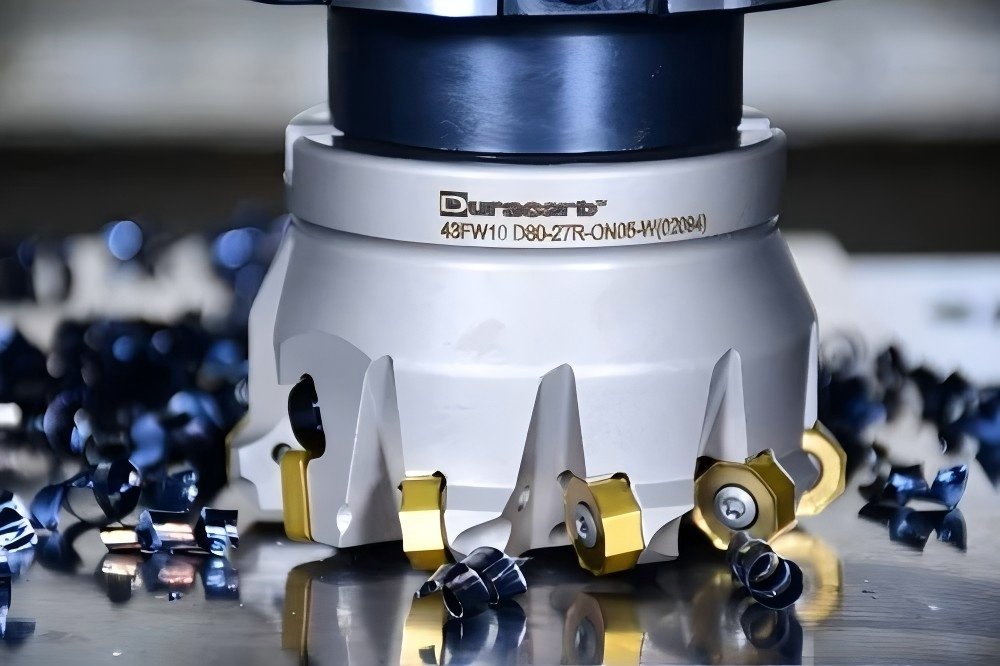
In modern CNC machining, tool selection isn’t just about brand name — it’s about predictable performance, supply chain consistency, and measurable cost per part. For job shops and distributors alike, the brand Duracarb has steadily gained attention in recent years because it offers a broad product range (milling, turning, drilling, grooving, threading) and a catalog structure that aligns with ISO standards.
In this article we go beyond surface marketing claims. We’ll highlight which Duracarb items currently show strong market signals (repeat listings, availability, stable pack sizes), which recent or under-hyped systems deserve attention (notably the D-CUT double-edge system), how to choose among their grades (DP5420, DC9800, DC9015 etc.), and how you as a distributor or online resale operator can build compelling catalog offerings around them.
Who is Duracarb and what’s their positioning?
Duracarb is part of the IMC (International Metalworking Companies) group, and positions itself as a full-line carbide cutting tools provider with manufacturing, quality systems, and global distribution. Their official product lines show sections for Milling, Turning, Hole-making, Grooving / Parting (DCut), Threading (DThread), indicating a “whole toolbox” philosophy.
From a distributor viewpoint, that is an advantage: you don’t need to maintain 20 different “boutique insert” brands; instead you can work with a fewer number of families and map them into broad job categories. The challenge is, of course, verifying performance and availability—and ranking which SKUs are safe bets.
Methodology: Why the items we picked
We screened public e-commerce and industrial supplier portals for Duracarb listings that show the following signals over the past 12–18 months:
The SKU appears repeatedly (repeat listing) with stock available, rather than one-time “new release.”
The SKU uses standard ISO geometry (APMT, TNMG, WCMX, etc.) and standard pack size (often 10 pcs) which eases distribution.
The grade is clearly identified (e.g., DP5420, DC9800) and the listing shows inclination toward a given substrate group (steel, stainless, etc.).
For newer systems (e.g., D-CUT), we looked at catalog documentation from Duracarb itself describing design features.
Based on that, three clusters emerge:
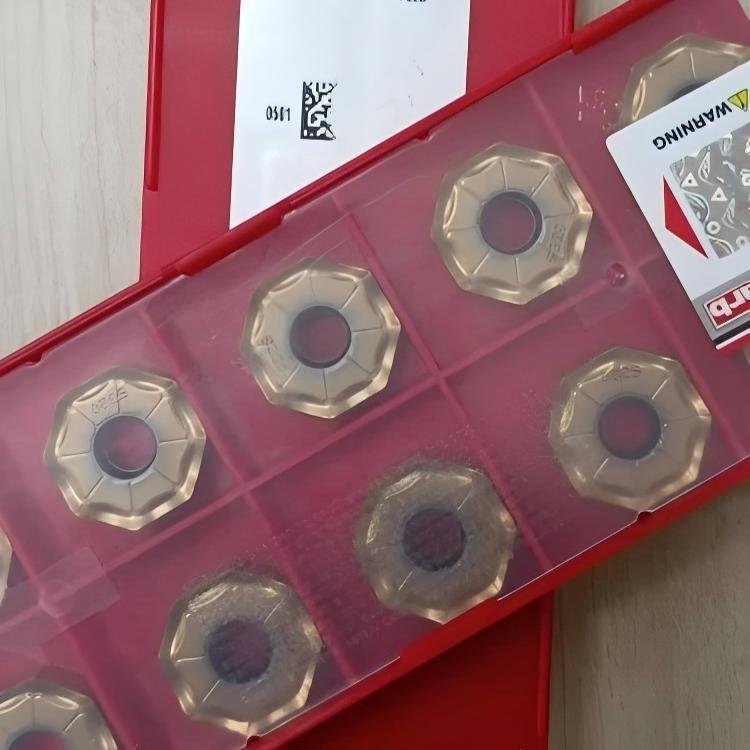
APMT style inserts (milling) in grades like DP5420 and DP5320.
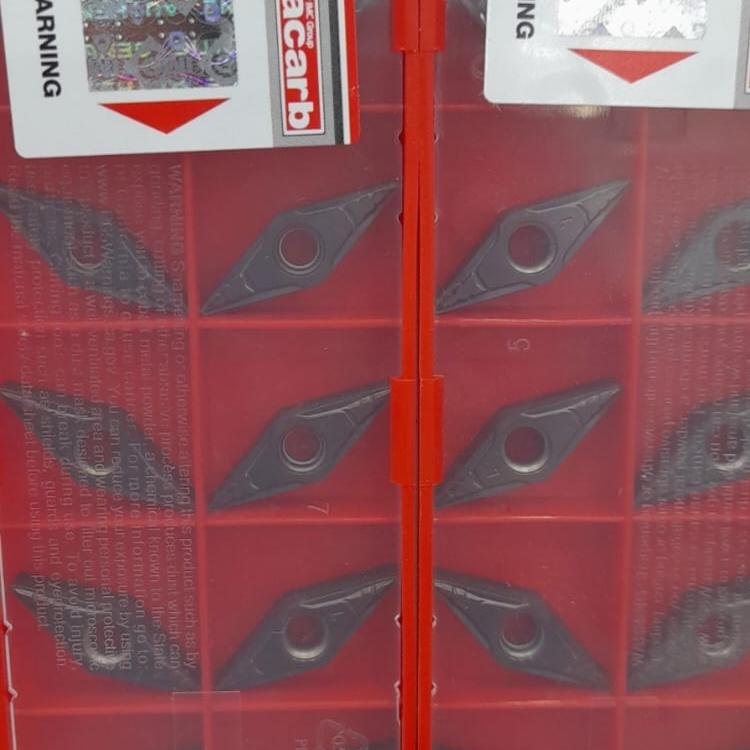
ISO turning inserts (TNMG, WCMX) in grade DC9800 (and sometimes DC9015/9010).
The D-CUT double-edge parting/grooving system.
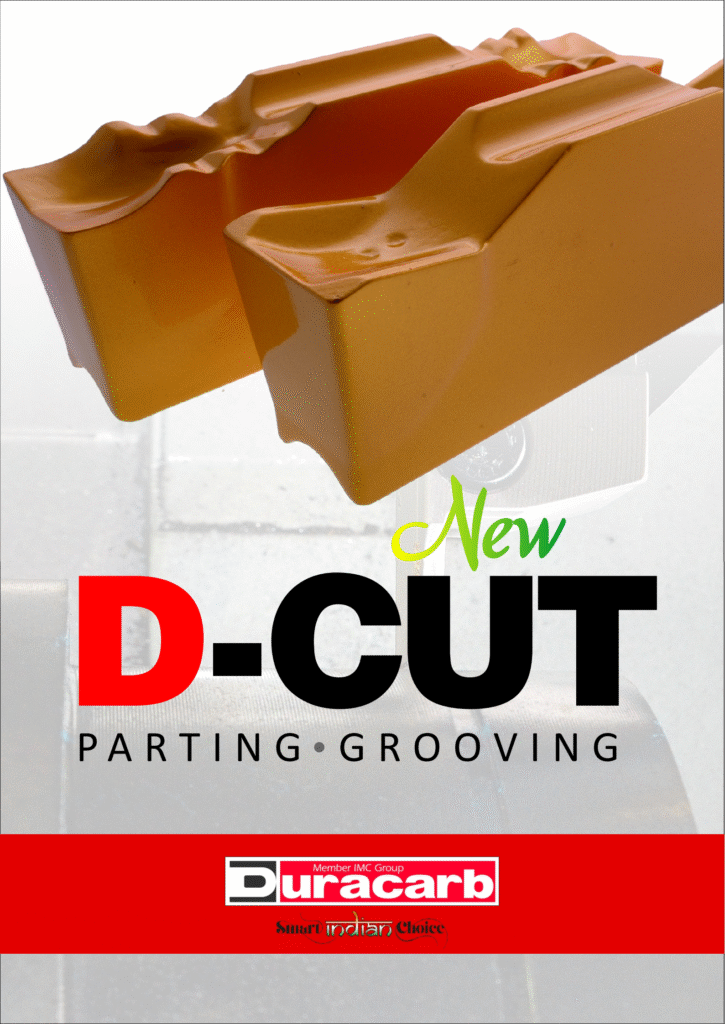
Duracarb DCut catalog
Popular SKUs & Applications
Below is a snapshot of the SKUs that meet the criteria for strong availability and distributor suitability.
Popular Duracarb SKUs & typical applications
SKU / Code | Grade | Operation | Workpiece Group | Notes |
APMT1135PDER | DP5420 | Face/slot/side milling | Stainless & alloy steels | Frequently listed in 10-pc boxes; appears in e-commerce listings. |
APMT1604PDER | DP5420 | General milling | Stainless & alloy steels | Also appears in listings such as Amazon. |
WCMX080412 | DC9800 | Turning / drilling seats | Steels | Appears in distributor stock listings (e.g., Duracarb web shop). |
TNMG160408-M3 | DC9800 | General turning | Steels | Standard geometry, good for finishing/medium turning. (Referenced in turning line discussion) |
These SKUs are particularly promising from a distribution standpoint: standard IC sizes, familiar geometries (APMT, TNMG), good substrate grades, and public listing signals.
The D-CUT System: Why it matters
One of the more interesting recent systems in the Duracarb catalog is D-CUT — a double-edge insert system for parting/grooving. The catalog describes the insert as having a prismatic top & bottom seat design, which helps lock it more securely than flat-seat systems.
Key advantages of D-CUT:
Mechanical rigidity: By using dual faces and locating surfaces, insert micro-movement is reduced.
Economy of edges: Each insert has two usable edges, effectively halving insert cost per usable edge compared to single-edge systems (if chip break is stable).
Better feed window: With higher rigidity you can push feed per rev better without chatter or tolerance drift.
Simplified inventory: Especially for users who part/groove on bar feeders, one system covers a range of diameters.
D-CUT vs Conventional Parting/Grooving Systems
Attribute | D-CUT Double-Edge | Conventional (single-edge) | Practical floor implication |
Insert/pocket geometry | Prismatic seat top & bottom | Flat seat, fewer locating surfaces | Less micro-movement, fewer pulls outs |
Feed window | Supports medium/higher feeds | Often conservative to avoid deflection | Shorter cycle times achievable |
Edge economy | Two edges per insert | One edge per insert | Lower cost per part if chip-break stable |
Material coverage | Steels, alloy steels, stainless | Varies by system | Simpler crib for lathe shops |
If you’re distributing to automated lathe cell users (bar feeders, in-line turn/mill cells), highlighting D-CUT as a value differentiator vs generic single-edge grooving systems can give you a sales edge.
Grades & How to Choose Them
Duracarb publishes a range of grades (coated/uncoated, various chipbreakers) — see their general catalog matrix. But we focus here on the grades most visible in distributor/retail listings and practical for mainstream job-shop use.
Common Grades
DP5420 — In milling, this grade appears often in stainless and alloy steel work. Example: APMT1135PDER in DP5420 is listed as “optimized for stainless & alloy steel, excellent wear resistance.”
DP5320 — Slightly more general steel-milling grade (less aggressive coatings, perhaps lower cost) and appears in some listings.
DC9800 — In turning, this grade appears repeatedly for ISO shapes like TNMG, WCMX. Good for general steel turning.
DC9015 / DC9025 — Seen in catalogs for finishing → medium cuts.
Other grades — From the 2019 catalog, you’ll find DC9235, DC9200, DP5015, etc., for various applications.
Distributor-Friendly Grade/Application Guide
Quick grade/application guide
Grade | Typical Family | Primary Use | Shop Tip |
DP5420 | APMT (milling) | Stainless & alloy steel milling | Keep 10-pc sleeves for min/max restock |
DP5320 | APMT (milling) | General steel milling | Use in smoother engagements where cost matters |
DC9800 | TNMG, WCMX (turning) | General steel turning | Standard radii (0.8 mm etc.) common |
DC9015 / DC9025 | ISO turning | Finishing → Medium cuts | Match proper chipbreaker (M3/D3) |
By focusing on these four to five grades you can keep your catalog reasonably constrained while covering a broad swath of job-shop work.
New Products / Emerging Signals
While many SKUs above are now “established,” there are still areas where Duracarb is pushing new or refreshed options:
Groove-Turn multifunction tools: In their turning tools page, Duracarb mentions “Groove-Turn tools are multifunction turning tools, able to operate in a sequence of grooving and turning modes.” This suggests they are targeting hybrid lathe operations (turn→groove) with dedicated tools, which may open cross-sell opportunities
Hole-making/Drilling hubs: The Duracarb catalog lists DEC-DRILL, Flex Head Drill, etc. For distributors who support tool-holders and drilling systems, adding these to your site gives you upstream coverage beyond just turning/milling.
Broader chipbreaker matrices: The 2019 catalog shows a wide range of chipbreaker codes (M3, D3, D5, R5) and substrate options (DC208, DP5015, DC9235 etc.). For shops doing exotic materials (HRSA, duplex stainless), having these “special” grades can differentiate your tool crib.
Pricing and e-commerce visibility: For example, the listing for APMT1135PDER DP5420 shows $29.82 USD for 10 pcs on a Chinese-based site (Oct 9, 2025)That gives you a baseline for margin planning.
How to Position Duracarb on Your Independent Site
1. Create clear “application buckets”
Segment your site into logical stacks such as:
Stainless/Alloy Milling → “Use DP5420, APMT1135/1604, etc.”
General Steel Turning → “Use DC9800, TNMG160408-M3 etc.”
High-Feed Lathe / Bar-feeder Everything → “Use D-CUT system for parting/grooving.”
This mapping helps your customers (job shops) understand which SKU to pick without deep catalog browsing.
2. Offer “Starter Kits” or “Tool Crib Packs”
Since Duracarb uses standard pack sizes (often 10 pcs) and common geometries, you could bundle e.g. 10× APMT1135PDER DP5420 + 10× APMT1604PDER DP5420 as a “Stainless Milling Starter Pack”. This simplifies ordering for small shops.
Likewise, a “Turning Starter Pack” could include WCMX080412 DC9800 + TNMG160408-M3 DC9800.
3. Highlight Cost-per-Edge and Total Cost of Ownership
Use the D-CUT as an example: show that using a double-edge insert halves cost per usable edge (assuming chip-break stable) compared to single-edge grooving systems. Provide a table or calculator showing that at feed of X mm/rev, Y insert life, you save Z%.
Show also publicly visible listing prices (e.g., $21.06 for 10 pcs APMT1135PDER DP5420 as of Oct 2025) so you can anchor “market price” and your margin.
4. Provide Technical Support Content
Because Duracarb may be less known than legacy big brands, offering downloadable PDFs, chipbreaker charts, and “how to pick the right insert” guides will reduce buyer friction. Pull from Duracarb’s catalog PDFs for accuracy.
5. Keep your stock lean but smart
Since you’re reselling, choose 10-20 SKUs that cover the majority of job-shop needs, then list “catalog special order” for the rest. Based on our survey, the 4–5 SKUs in Table 1 already cover a broad swath. Buying signals suggest they move.
Performance and Real-World Insights
Though independent third-party benchmarks of Duracarb vs premium brands (Sandvik, Kennametal, etc.) are limited in the public domain, the catalog emphasizes consistent manufacturing tolerances, metallurgical lab, and global quality systems.
From distributor feedback (forum comments, reseller listings) you see that job shops often adopt Duracarb when they want “good performance at fair cost” and when they value quick availability of standard geometries (rather than waiting on exotic special grades). For example, you’ll find multiple listings showing “stock items ship within 24 hrs” for APMT1135PDER DP5320.
One subtle point: because Duracarb is building its brand visibility, it may still have fewer application-engineering case studies compared to the major legacy brands. That means your sales narrative should emphasize reliable geometry + smart supply chain rather than “top elite performance” (unless you or your tool engineers have proof in house).
Risk Factors & What to Monitor
Authenticity / branding: Because Duracarb uses standard insert geometries, there’s risk of unofficial or grey-market versions. Always verify with your supplier for genuine Duracarb parts.
Stock continuity: While many SKUs are repeat listings, you should monitor lead time changes or delisting in e-commerce listings (could indicate supply chain or end-of-life issues).
Special materials: For exotic alloys (Ti, HRSA, super-duplex), you may need high-end grades beyond DP5420/DC9800. Confirm with Duracarb or your supplier before recommending to customers.
Marketing support: The brand may have less marketing collateral than major brands; you as reseller may need to generate your own content (application videos, tooling bulletins, etc.).

Sample Workflow: From Inquiry to Sale
Customer says: “I’m milling 316L stainless bracket, operation: face + slot + side, cutter body takes APMT insert.”
You propose: Duracarb APMT1135PDER DP5420 (and optionally APMT1604PDER DP5420) with recommended speeds/feeds from the catalog. Reference listing where available at ~$21 USD / 10 pcs.
Provide value: “You can keep a 10-piece sleeve, reorder when stock hits 3 pcs; our shipping allows 24-48h dispatch for this SKU.”
Upsell: Add matching cutter body + recommend when feed or DOC changes, considering D-CUT if they also grooving.
After sale: Ask for tooling feedback, collect edge life data, feed into your “customer success case” to enhance future marketing.
Conclusion
In 2025, Duracarb is a compelling option for CNC cutting tools distribution. Its strongest value isn’t in flashy “top premium” marketing; it lies in offering standard geometries, good availability, practical grades, and a catalog architecture that aligns with ISO nomenclature. For your independent site serving CNC job shops, you can build around a tight core of SKUs (e.g., APMT1135/1604, TNMG160408, WCMX080412, D-CUT system) and then expand as your tool crib matures.
By focusing on the combination of “availability + known geometry + application clarity,” you reduce the friction for your customers (shop owners, purchasing agents) and increase the trust they place in your site as a reliable tooling source. The next step: create strong landing pages for each SKU, bundle them logically, provide clear application guides, and track reorder metrics. That turns a one-time sale into a recurring tool crib relationship.