

Table of Contents
2024 Supplement Highlights (What’s New & Why It Matters)
Threading is unforgiving. A few microns of runout, the wrong rake, or a bottom-hole that’s 0.1 mm off can turn a “five-minute” op into a scrap maker. STOCK’s 2024 additions target the high-friction corners of threading: gummy stainless, tiny pitches, blind holes with poor chip escape, and micro features that used to demand specialty vendors.
What’s in focus this year
Machine Taps (cutting), expanded: Material-tuned geometries for carbon steel, stainless, aluminum, and cast iron; more blind-hole spirals and semi-bottoming options.
Form (roll) taps, extended diameters: Larger metric and UNC/UNF coverage for ductile materials; stronger tooth forms; lower torque at correct bottom-hole sizes.
Micro Thread Milling: Solid-carbide mills down to sub-M2 with short/necked variants, reaching deep without deflection; partial and full-profile choices.
Grades & Coatings: Broader HSS/HSSE and micro-grain carbide ranges; PVD (TiN/TiCN/TiAlN) and low-adhesion options for aluminum/SS; selected AlTiN for heat resistance.
Standards & Sizes: Wider DIN/ISO/UNC/UNF and pipe threads (G/Rp) bring inch and tube work onto the same shelf.
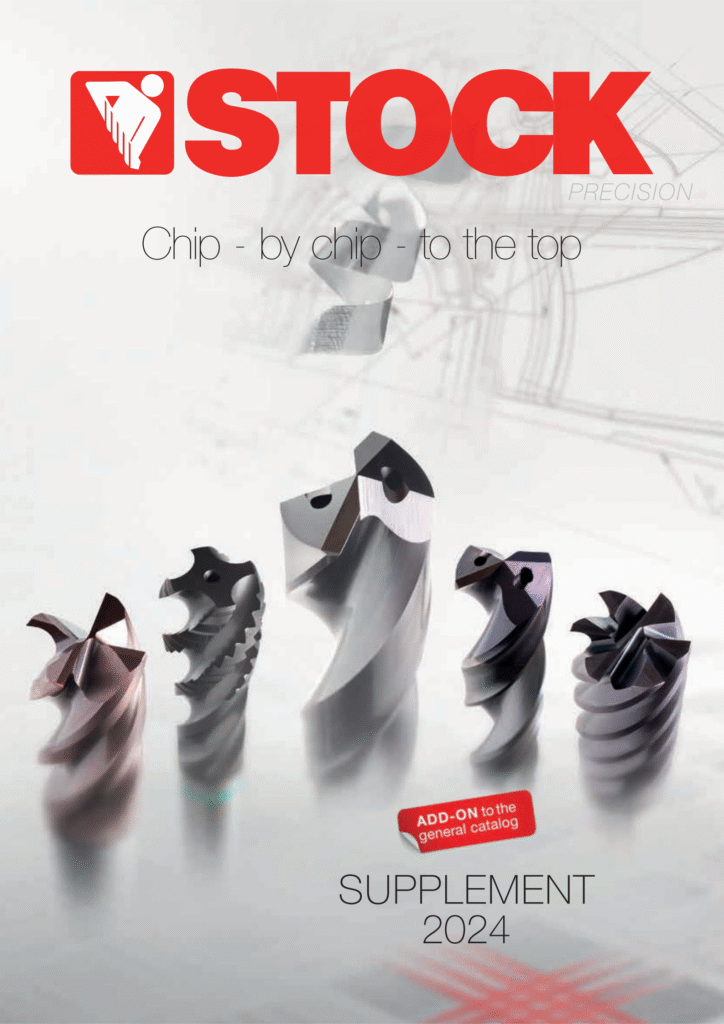
STOCK General Catalogue Supplement 2024
The Threading Family at a Glance
Think of STOCK’s lineup as three levers you pull based on hole type, material ductility, and machine capability.
Machine Taps (cutting): Make and carry chips. Choose spiral flutes for blind holes, straight/gun for through holes. Best when the machine can rigid-tap and chips can be evacuated.
Form Taps (roll): Displace material instead of cutting—zero chips. Require ductile substrates and larger bottom-hole diameters vs. cut taps. Resulting threads are strong at the root.
Micro Thread Mills: Mill the thread with a helical toolpath. Slowest but most controllable for tiny threads, tough alloys, thin walls, and shallow shoulders. One tool covers multiple pitches if you program it.
2024 Additions Overview
Product Family | New/Expanded Range | Hole Type | Material Focus | Why Pick It First |
Machine Taps (Cutting) | More blind-hole spirals; semi-bottoming points | Blind & Through | Carbon steels, stainless, cast iron, Al | Fastest cycle time; uses existing holders; excellent for production cells |
Form Taps (Roll, Chip-Free) | Wider metric & inch diameters; stronger tooth forms | Blind & Through | Ductile steels, Al, Cu alloys | Zero chips, strong thread roots, long tool life; less sensitive to mis-drilled holes |
Micro Thread Mills | Sub-M3 diameters; necked reach; partial/full profile | Blind & Through | Stainless, HRSA, thin walls | Absolute control of pitch & fit; best for micro features and tricky alloys |
Materials & Coatings (HSS/HSSE/Carbide · PVD/AlTiN)
Substrate & geometry do the heavy lifting; coating finishes the job.
HSS/HSSE: Forgiving, tough edges for general work, mixed materials, and legacy machines with floating holders.
Carbide: Stiffer and more heat-resistant—ideal for micro thread mills and high-speed tapping on rigid machines.
Coating playbook
TiN: Universal, low friction, easy wear readout—great starter for steels.
TiCN: Higher hardness & lubricity; standout in stainless to reduce galling.
TiAlN/AlTiN: Hot-hard for alloy steels and tougher duty cycles; survives dry spots better.
Low-adhesion (DLC-like): For aluminum and low-Si stainless where built-up edge (BUE) is the enemy.
Typical Materials & Work Conditions
Carbon & Alloy Steels (C45, 42CrMo4): Prefer robust rake and land support. TiN/TiAlN on cut taps; form taps excel in low-carbon grades.
Stainless (304/316/321): Needs high lubricity and a chipbreaker/spiral that keeps chips short. TiCN or low-adhesion PVD reduces cold welding.
Aluminum (6061/7075 & cast Al-Si): Use polished rake and high-shear forms; DLC-like coatings fight adhesion. Form tapping is often the top-life option.
Cast Iron (GG/GGG): Straight-flute or low-spiral taps; TiN/TiAlN; dry or MQL possible thanks to free chips.

Standards & Size Coverage
Metric & Pipe: DIN/ISO metric coarse/fine (M), pipe threads G (BSPP) and Rp; NPT/NPTF availability by series.
Imperial: UNC/UNF coverage expanded in both taps and micro thread mills—use one vendor for mixed fleets.
Micro Range: Thread mills and taps extending into M0.8–M3 class with short and necked options for deep or obstructed features.
Quick Selector (Hole • Material • Lubrication → Tool & Coating)
Use the table to shortlist in seconds. Then fine-tune with the parameter windows below.
Selection Matrix
Hole Type | Material | Lubrication | Preferred Tool | Backup / Alt. | Recommended Coating |
Blind | Stainless (304/316) | Flood / MQL | Spiral-flute cut tap | Form tap (if ductile grade) | TiCN (or low-adhesion for galling) |
Through | Carbon/Alloy steel | Flood / HP | Gun/straight-flute cut tap | Form tap (low-carbon) | TiN or TiAlN (heavy duty) |
Blind | Aluminum (wrought) | MQL / Flood | Form tap | Spiral-flute cut tap | DLC-like low adhesion |
Through | Cast iron | Dry / MQL | Straight-flute cut tap | Micro thread mill (thin wall) | TiN/TiAlN |
Blind/Through | Thin-wall / HRSA / Tiny pitch | Flood / HP | Micro thread mill | Spiral-flute cut tap (if feasible) | AlTiN/TiAlN on carbide |
Parameters You Can Start With (and How to Tune)
Always confirm bottom-hole diameters, gauge class, and machine rigidity. For rigid tapping, feed equals thread pitch (fz = P). For micro thread milling, use constant lead helical paths and verify runout ≤ 5 µm.
Tapping — Starting Windows (HSS-E unless noted)
Carbon/Alloy Steel: 10–25 m/min; moderate feed (pitch); soluble oil or HP coolant; avoid dwell at reversal.
Stainless: 6–15 m/min; TiCN; strong MQL or EP oil; keep spiral 35–45° for blind holes.
Aluminum: 20–40 m/min (cut); 25–60 m/min (form); DLC-like or polished edges; MQL works well.
Cast Iron: 10–25 m/min; straight flute; dry or light MQL; control entry burr with a countersink.
Bottom-hole sizes (form taps vs. cut taps)
Form taps require larger bottom-holes. Example (starting points):
M4×0.7: cut 3.3 mm; form 3.5–3.6 mm
M6×1.0: cut 5.0 mm; form 5.4–5.5 mm
Adjust for alloy and required % thread (form taps often target 65–70% engagement).
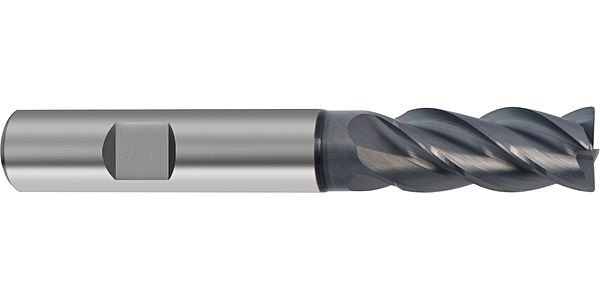
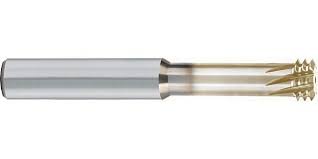
Micro Thread Milling — Starting Windows (Carbide)
Tool Ø ≥ 1.0 mm (e.g., M2): 60–120 m/min surface speed; fz 0.005–0.015 mm/tooth; ap per pass 0.2–0.4 × P; climb cut, 1–3 passes + spring pass.
Tool Ø 0.5–1.0 mm (M1–M1.6): 40–80 m/min; fz 0.003–0.010 mm/tooth; keep radial engagement light; verify runout ≤ 3–5 µm.
Ti/HRSA: Drop to 20–40 m/min; AlTiN; maximize coolant aim at the helical chip.
Case Notes: Speeds, Life, and What Changes in Practice
Real-world outcomes depend on length-to-diameter, coolant aim, and bottom-hole quality. The patterns below are typical when the tool matches the material and the pilot hole is correct.
Example Results (Directionally Representative)
Scenario | Legacy Setup | 2024 STOCK Choice | Speed (m/min) | Result (Holes/Tool or Ra) | What Changed |
M6 × 1.0 in 304 blind (20 mm deep) | General spiral cut tap, TiN | Spiral cut tap, TiCN | 10 → 14 | 350 → 520 holes | Better lubricity, cleaner chips, less torque at reversal |
M8 × 1.25 in 6061 through | Spiral cut tap | Form tap (DLC-like) | 25 → 45 | 1,200 → 3,000+ holes | Zero chips, larger pilot, reduced friction |
M2 × 0.4 in 316 thin wall | Hand tap / die | Micro thread mill (AlTiN) | N/A → 70 | Ra 1.2 → 0.6 µm flank | Rigid helical path; no chip packing |
G1/8 (BSPP) in cast iron | Straight tap, dry | Straight tap, TiN | 18 → 22 | 500 → 750 holes | Cleaner entry burr, steadier torque |
Compatible Standards & Dimensions (What You Can Order)
Threads: Metric coarse/fine (M), UNC/UNF, G (BSPP), Rp; selected NPT/NPTF availability.
Diameters & Pitches: Broad coverage from micro (M0.8–M3) up through common plant sizes (M4–M20, 1/4″–3/4″).
Lengths & Reaches: Standard, short, and neck-relieved micro thread mills for deep pockets or shoulder clearance.
Shanks & Holders: DIN/ISO square shanks for taps; cylindrical for thread mills; compatible with rigid tapping holders, ER collets, and shrink/hydraulic for micro tools.
Application Patterns You Can Deploy Tomorrow
Stainless pump cover, blind M6 × 1.0
Tool: Spiral-flute cut tap, TiCN, semi-bottoming.
Setup: Rigid tapping; MQL with EP additive; verify pilot 5.0 mm.
Why it works: Lubricity + high spiral keeps chips moving; semi-bottoming minimizes torque at the floor.
Aluminum housing, through M8 × 1.25
Tool: Form tap (DLC-like), polished lands.
Setup: MQL; pilot 7.3–7.4 mm; rigid feed = pitch.
Why it works: No chip management; threads form cold with excellent root strength and finish.
Medical stainless bracket, M2 × 0.4 near an internal corner
Tool: Micro thread mill, neck-relieved, AlTiN.
Setup: Shrink/hydraulic holder; runout ≤ 3 µm; 2–3 passes + spring pass.
Why it works: Zero push-off, controllable pitch, no chip nests.
Cast iron manifold, G1/8 BSPP
Tool: Straight-flute tap, TiN.
Setup: Dry or light MQL; strong countersink; rigid cycle.
Why it works: Free chips, strong tap, minimal heat sensitivity.
Support Tools & Services (Keep the Edge Working)
Regrinding: Extend drill/tap life where geometry allows; STOCK provides grind specs so cutting points, margin widths, and chamfers return to factory intent.
Coating Services: Refresh TiN/TiCN/TiAlN or low-adhesion films to match your material mix; coating after regrind restores heat and friction behavior.
Tool Management / Tool Depot: Bin carding, preset kits (e.g., “M6 blind set: pilot + tap + gauge”), and consumption reporting.
On-Machine Aids: Bottom-hole charts, countersink standards, and torque watch points placed at the machine reduce operator guesswork.

Fast FAQ
Q: When should I choose form tapping over cut tapping?
A: In ductile materials (Al, low-carbon steels) where you want zero chips, longer tool life, and stronger thread roots. Use the larger pilot sizes shown for form taps.
Q: Why are my stainless taps seizing near reversal?
A: Likely galling and chip packing. Switch to TiCN or a low-adhesion PVD, increase spiral angle (blind holes), and improve lubrication aim.
Q: Do micro thread mills need shrink or hydraulic holders?
A: Strongly recommended. Micro tools are stiffness-limited; ≤ 5 µm runout is the difference between a crisp crest and a torn flank.
Q: Can I rigid-tap cast iron dry?
A: Yes, with straight-flute taps and good countersinks. Watch entry burrs; a brief MQL pulse can improve gauge fit.
Q: How do I tune speeds quickly?
A: Start mid-range for the material, increase feed until chips break cleanly (for cut taps), and watch peak torque at reversal. For micro milling, keep fz conservative and add a spring pass.