
Table of Contents
What’s New: Swiss-Line G4 at a Glance
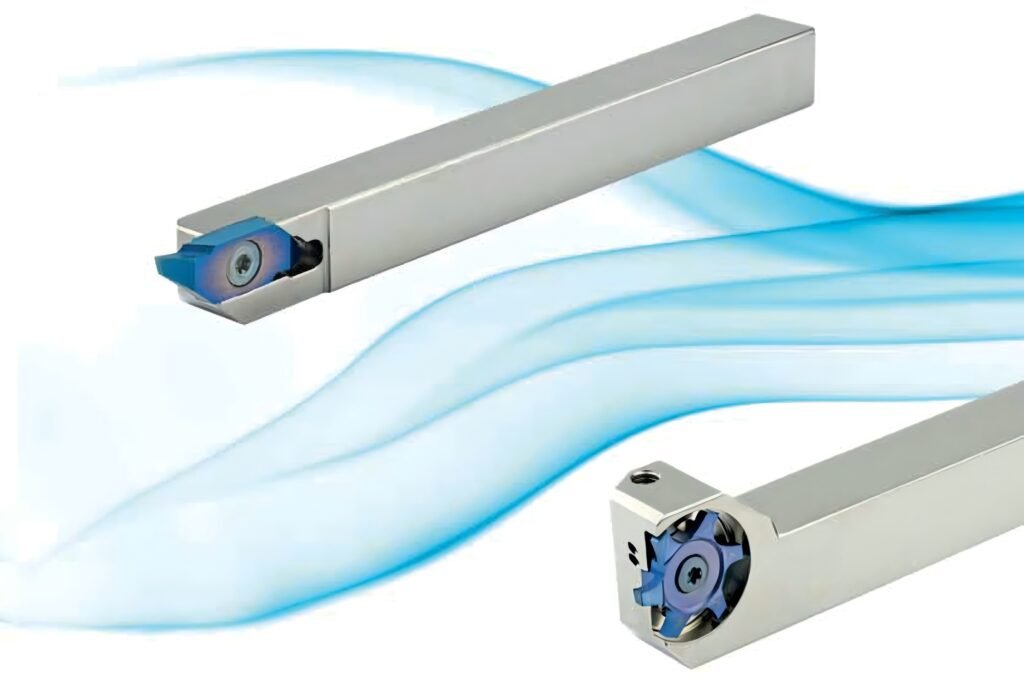
The G4 platform rethinks how you spec small turning tools. Instead of separate SKUs for groove/part/thread, you can standardize on a unified insert family and clamp system that holds tolerance across all three. The result: shorter BOMs, faster changeovers, and predictable costs per edge.
Why G4 is different
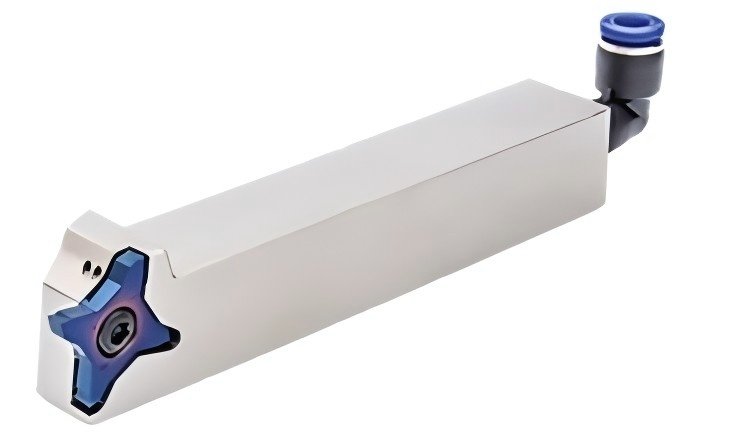
4 cutting tips per insert: two per side, indexable—double the economy vs. typical two-edge designs.
Multi-function grinds: primary geometry for grooving & parting, secondary lands that stabilize thread turning (V-form and partial profile).
All-ground accuracy: consistent width, radial position, and edge prep, minimizing pitch error and shoulder mismatch.
Coolant-first construction: directed jets into the shear zone on parting and into the root on thread passes—less notch wear, cooler chips.
Rigid pocket + anti-slip seat: positive axial stop and wedge clamp transmit forces into the holder body, not the screw.
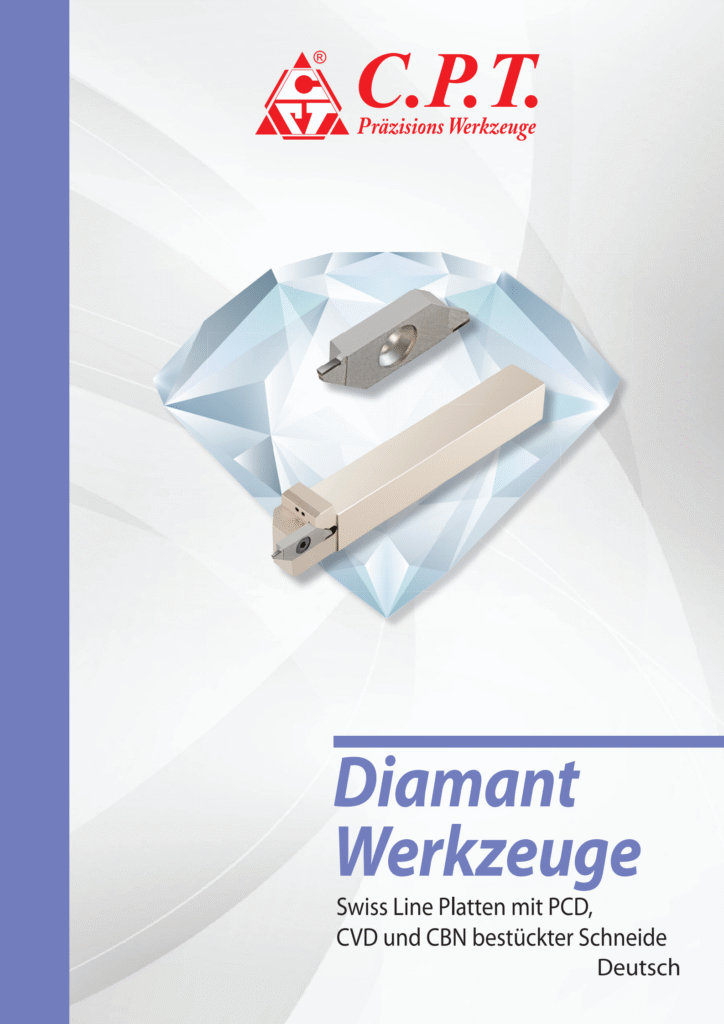
Diamant Werkzeug Swiss-Line
System Architecture: From Insert to Coolant Path
1) Inserts (the G4 heart)
Widths: slim micro-groove to standard slot widths, with dedicated part-off noses to protect corners in deep cuts.
Threading profiles: ISO metric (60°), UN (60°), partial profile variants to follow crest tolerances; grooving-to-threading transitions use the same seat.
Edge prep: micro-hone to fight micro-chipping in hardened or stringy steels; sharp/rake-optimized edges for stainless and thin-wall parts.
2) Toolholders / Boring Bars
Shank sizes: compact sizes for Swiss guides (8–16 mm; 5/16–5/8″) and standard lathe blocks (20–25 mm; 3/4–1″).
Pocketing: ground datum faces with axial locators; wedge clamp resists lift in parting cuts; optional anti-rotation pins for heavy feeds.
Overhang management: short-gauge lengths for guide-bushing machines, and neck-relieved variants for reaching past fixtures.
3) Coolant Layout
OD turning: top and under-flute nozzles converge at the chip root for immediate breakage.
ID/Shoulder work: side discharge options keep flow even when the tool is rotated for flank access.
Pressure capability: designed to benefit from medium-to-high pressure (20–70 bar), yet still effective with flood.
4) Quick-change efficiency
Seat & screw commonality: one screw/seat family across multiple widths; fewer spare parts to manage.
Indexed in seconds: flip, index, and clamp—length offset remains near constant thanks to axial stops.
Chip Control & Rigidity: Stability You Can Hear
CPT’s G4 breaker geometries are tuned to stop long, stringy chips before they knot around the part. On stainless and low-carbon steels, the breaker lifts the ribbon and snaps it into consistent curls; on hardened steels, a leaner rake narrows chip thickness to keep torque linear.
What you’ll notice in the cut
Smoother sound at higher feeds—less “singing” during long parting strokes.
Lower peak torque on thread entries and exits—threads gauge cleanly, flanks aren’t torn.
Longer edge life thanks to directed coolant that quenches the hottest point (the chip root) instead of the tool’s flank alone.
Changeover wins
One insert style covers groove/part/thread on many jobs. Fewer tool calls and fewer offsets to babysit mean minutes back per setup.
Four usable tips radically reduce the cost per finished feature—especially in lights-out cells.
Typical Use Cases
Stainless (304/316/321)
Challenge: adhesion and springy chips that re-cut.
G4 answer: high-shear primary rake with a deep breaker pocket; DLC-like low-friction coatings available.
Outcome: quick chip segmentation, lower burr at groove shoulders.
Alloy steels (4140/4340, QT)
Challenge: notch wear in parting and crater wear in threads at higher SFM.
G4 answer: tougher grade with micro-hone; coolant jets damp thermal spikes.
Outcome: more inserts per bar; clean flank finish.
Hardened materials (>40–55 HRC)
Challenge: brittle edge chipping, heat at the thin chip root.
G4 answer: reinforced corner lands and lean rake; conservative radii maintain edge strength.
Outcome: reliable micro-grooves and accurate thread form without crest crumble.
Thin-wall & small-diameter Swiss parts
Challenge: wall collapse and push-off during parting.
G4 answer: rigid pocketing and narrow land contact reduce radial load; coolant supports chip evacuation without flooding the guide bushing.
Outcome: straighter parting faces, fewer scratches on OD.
Parameter Guidance (Start Here, Then Tune)
Use the ranges below as your conservative starting window. Increase feed until chips break cleanly; adjust surface speed to stabilize torque and temperature. Always consider your machine’s rigidity, overhang, and coolant pressure.
Recommended Cutting Windows
Material / Operation | Cutting Depth ap (mm) | Feed fn (mm/rev) | Surface Speed vc (m/min) | Notes |
Stainless 300-series — Grooving | 1.0–3.0 | 0.03–0.09 | 90–140 | Use higher feed to break chips; keep coolant directed |
Stainless 300-series — Parting | up to 1.5 × insert W | 0.05–0.12 | 90–130 | Shorten overhang; steady rest or guide support helps |
Stainless 300-series — Threading | 0.05–0.10 per pass | 0.05–0.10 | 60–100 | Multi-pass; reduce last pass to polish |
Alloy Steel 41xx — Grooving | 1.0–3.5 | 0.04–0.10 | 120–180 | Tough grade + medium pressure coolant |
Alloy Steel 41xx — Parting | up to 1.5 × insert W | 0.06–0.14 | 120–170 | Keep chip load constant into the core |
Alloy Steel 41xx — Threading | 0.05–0.12 | 0.06–0.12 | 80–130 | Watch heat at root; avoid dwell |
Hardened 45–55 HRC — Grooving | 0.5–1.5 | 0.02–0.06 | 60–100 | Lean rake geometry; micro-hone |
Hardened 45–55 HRC — Parting | up to 1.2 × insert W | 0.03–0.08 | 50–90 | Small nose radius; maintain straight entry |
Hardened 45–55 HRC — Threading | 0.03–0.08 | 0.03–0.08 | 40–80 | More passes, minimal spring pass depth |
Specifications & Interfaces
The G4 family targets the thread and groove standards you run every day, with enough width and shank coverage to consolidate your drawer.
Standards, Widths & Holder Sizes
Category | Coverage |
Thread Profiles | ISO metric 60°, UNC/UNF 60°, partial profile options; additional trapezoidal/pipe forms available on request |
Groove/Part Widths | ~0.5–3.0 mm micro-groove; 3–6 mm standard slotting/parting; nose options for plunge or side-turn |
Shank Sizes | Swiss: 8 / 10 / 12 / 16 mm (5/16, 3/8, 1/2″); Standard lathe: 20 / 25 mm (3/4, 1″) |
Coolant Interfaces | Through-holder standard; side/top nozzle adapters; compatible with typical 20–70 bar systems |
Seat / Clamp | Common seat & screw across widths; anti-slip texture; positive axial stop |
Coatings | PVD TiAlN/TiCN for steels; low-friction options for stainless; hard, lean geometries for hardened stock |
Cost, Uptime & Edge Economy
The four-edge concept pays for itself fast on production bars and high-mix Swiss work:
Cost per edge: effectively halves vs. two-edge competitors, then drops further as you spread one insert across three operations.
Uptime: unified insert and seat mean fewer tool calls, fewer offsets, and faster indexing—index in seconds, not minutes.
Quality: all-ground width and datum positioning deliver repeatable groove shoulders and thread pitch location without touch-off roulette.
Real-World Setups (Patterns That Work)
Stainless flange with groove + M12×1.75 thread
Tooling: G4 2.0 mm groove/part insert; G4 60° threading insert, same holder.
Process: groove first, then thread with short spring pass; part last with high feed to keep chips short.
Outcome: one holder, two inserts, 4 indexed lives each—low burr, gauge-clean threads.
4140 shaft with two retaining grooves + part-off
Tooling: G4 3.0 mm insert for grooves and part-off; same pocket/seat.
Process: plunge-groove, side-turn to width, part at the end with constant feed.
Outcome: constant chip shape, smooth face after part-off, longer seat life thanks to rigid wedge clamp.
Hardened pin, micro-groove + fine pitch thread
Tooling: narrow G4 micro-groove + partial-profile thread insert (lean rake, micro-hone).
Process: short passes, lower SFM, frequent coolant pulses into root.
Outcome: no crest crumble, clean flanks, predictable edge wear.
Compare & Replace: Why Switch Now
Whether you’re on earlier CPT “G” families or a mix of other brands, G4 simplifies the drawer while upgrading the cut.
Replacement Matrix
Scenario | Legacy Tooling | Switch To | What Improves |
Separate groove & part inserts, 2 edges | Generic 2-edge | G4 multi-function, 4 edges | Half the cost per edge; fewer offsets; faster changeover |
Threading on a dedicated system | Single-purpose thread tool | G4 thread insert in same holder | One holder for groove/thread; better coolant to thread root |
Stainless chip nests at parting | Flat rake, weak breaker | G4 stainless breaker | Reliable chip segmentation; lower burr; quieter cut |
Notch wear in 41xx part-off | Soft grade, steep rake | G4 tough grade + micro-hone | Longer life, stable face finish |
Hardened micro-groove failures | Brittle sharp grind | G4 lean rake + reinforced corner | Less chipping, accurate groove walls |
Implementation Tips (Get the Best Out of G4)
Shorten the lever: Use the shortest holder/overhang you can; stiffness pays back instantly in parting stability.
Feed to break: In stainless, feed rate—not speed—is your chip breaker. Don’t starve the edge.
Aim the coolant: Point one jet at the chip root and another across the flank; high pressure is nice, aim is essential.
Index proactively: Change edges on schedule (by part count or time). Waiting for finish drift is more expensive than an early index.
Match width to the job: Narrower than necessary invites heat; too wide abuses torque. Choose the width that matches groove callout plus minimal flank allowance.

FAQs
Can one G4 insert really do groove, part, and thread?
Yes—width/profile variants cover each task. Most shops standardize on a groove/part insert + a thread insert using the same holder and seat.
Will four edges compromise rigidity?
No. The pocketing and wedge clamp lock the insert against axial and radial movement; edges are identical by grind, not by sintered coincidence.
What about tiny pitches?
Partial-profile G4 options handle fine pitches cleanly; reduce step depth on final passes and maintain coolant at the root.
Do I need high-pressure coolant?
It helps on stainless and deep parting, but aim matters more than absolute pressure. The G4 nozzle geometry makes flood coolant more effective.
Ready to Consolidate?
Reduce SKUs, raise stability, and cut cost per feature. CPT Swiss-Line G4 turns one pocket into a groove/part/thread workstation—with four true indexed edges and the chip control to back higher feeds. Standardize now, measure the torque trace, and watch scrap rates fall.