

Table of Contents
New Products at a Glance
Inserts
1) Precision Finishing Insert—Micro-Geometry for Stainless
Sells on: (a) Anti-adhesion rake polish for 304/316 burr control; (b) Stable edge-hone for consistent Ra; (c) Predictable wear scar for SPC.
Materials: Austenitic stainless (M), free-cutting ferritic; light finishing on low-alloy steels.
Start window: Vc 90–160 m/min, fn 0.05–0.20 mm/rev (turning), directed emulsion; Ready to Run.
2) Heavy-Duty Roughing Insert—Cast Iron & Low-Alloy Steel
Sells on: (a) Thick, secure chipbreaker; (b) Notch-resistant edge for scale; (c) Heat-tolerant coating for long duty cycles.
Materials: K/P groups—gray/ductile iron, C45, 42CrMo (normalized).
Start window: Vc 140–240 m/min (K), fn 0.15–0.35 mm/rev; emulsion or dry with extraction.
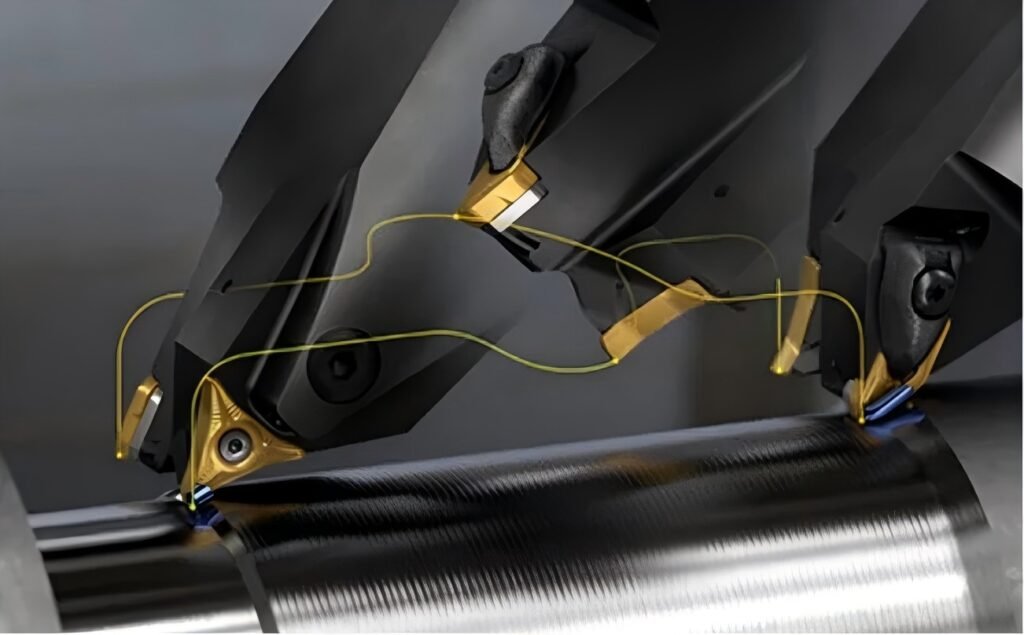
Milling Cutters
3) High-Feed Face Mill—Thin Chip, High MRR
Sells on: (a) High-feed geometry for shallow ap and high fz; (b) Low cutting forces for slender setups; (c) Excellent per-edge economics.
Materials: P/M/K; excels on steels and cast irons.
Start window: ap 0.5–1.2 mm, fz 0.25–0.45 mm/tooth, Vc 180–260 m/min; emulsion; Ready to Run.
4) Finish-Grade Shoulder Mill—Hardened Steel & EDM Replacement
Sells on: (a) Polished rake for low burr; (b) Edge integrity at 50–58 HRC; (c) 90° shoulders within tight flatness.
Materials: Hardened tool steel (H), mold steels.
Start window: ap 0.2–0.6 mm, ae ≤ 15%Ø, fz 0.05–0.12, Vc 120–180 m/min; rich emulsion.
Drilling
5) Through-Coolant Solid Carbide Drill—Mixed-Material Cells
Sells on: (a) Self-centering split point; (b) Fast chip evacuation on 3–5×D; (c) Stable diameter across changeovers.
Materials: P/M/N; suitable for 304/316 and Al 6xxx.
Start window: 304/316: Vc 60–120 m/min, f 0.10–0.22 mm/rev, 30–50 bar emulsion; Ready to Run.
6) Exchangeable-Head Drill—Mid/Large Ø Cost Control
Sells on: (a) Body reuse reduces per-diameter spend; (b) Repeatable head seating; (c) Fast head swaps for high-mix lines.
Materials: P/M/K; deep holes with through-coolant.
Start window: See Parameter Card for Ø-specific Vc/f and pressure.
Toolholders
7) Precision Capto Tooling—Short Gage Length, Fast Preset
Sells on: (a) Repeatable length for fewer retouches; (b) Low runout for bore quality; (c) Simple changeovers reduce downtime.
Use cases: Swiss cells, horizontal lines, and mold finishing.
Start window: Follow cutter/insert card; ensure TIR ≤ 0.01–0.02 mm at edge.
Digital & Tool Data Updates
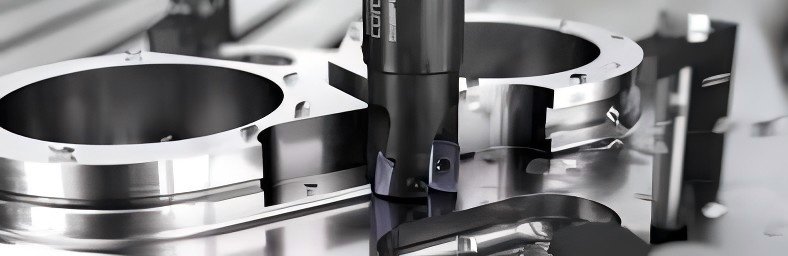
Why ISO 13399 Matters to CAM
ISO 13399-standardized tool data ensures predictable import into CAM and simulation: accurate cutter diameters, length/assembly stacks, recommended cutting conditions, and collision envelopes. Good data cuts hours from programming and helps prevent small but expensive mistakes (like wrong gauge length on a deep bore).
Tool Libraries, Optimization, and Connectivity
Tool libraries: Updated turn/mill/drill families arrive as ready-to-load bundles, reducing manual entry.
Optimization: Template feeds/speeds and chip-control logic (e.g., high-feed vs. shoulder) pre-wire safer defaults; you still tune for your machine/material.
Connectivity: Look for smoother links between tool data → CAM → presetting → machine, so offsets and assemblies match exactly.
Compatibility Tips
Keep a shadow copy of your current library; import new families side-by-side.
Use consistent naming conventions (family-diameter-L/D-holder) so programmers and operators speak the same language.
Confirm post-processor support for any new canned cycles or high-feed strategies before shop release.
ROI Calculator Template
Three value streams produce most of the return:
Tool life uplift (fewer heads/inserts per year)
Cycle-time reduction (shorter takt or higher MRR)
Quality yield improvement (less scrap/rework/time-on-CMM)
ROI Inputs & Outputs
Input / Output | Symbol | Unit | Example |
Tool cost per edge/head | CtC_tCt | $ | 35.00 |
Holes/edges per tool | NNN | parts | 900 |
Machine + operator rate | RmR_mRm | $/min | 2.00 |
Cycle time change | ΔT\Delta TΔT | min/part | −0.12 |
Scrap/rework reduction | ΔS\Delta SΔS | $/part | 0.03 |
Changeover minutes saved | ΔC\Delta CΔC | min/change | 4 |
Changes per week | FcF_cFc | # | 12 |
Tooling cost/part: Ctool=Ct/NC_{tool} = C_t / NCtool=Ct/N
Time value/part: Vtime=Rm×ΔTV_{time} = R_m \times \Delta TVtime=Rm×ΔT
Changeover value/part: Vchg=Rm×(ΔC×Fc/weekly parts)V_{chg} = R_m \times (\Delta C \times F_c / \text{weekly parts})Vchg=Rm×(ΔC×Fc/weekly parts)
Quality value/part: Vqual=ΔSV_{qual} = \Delta SVqual=ΔS
Total delta/part: ΔP=−Ctool+Vtime+Vchg+Vqual\Delta P = -C_{tool} + V_{time} + V_{chg} + V_{qual}ΔP=−Ctool+Vtime+Vchg+Vqual
Run the math for A/B trials and confirm with one month of production data before scaling.
A/B Trial Flow—From Sample to Volume
Phase | Scope | Timebox | Data to Capture |
Sample | 5–20 parts | 1–2 days | Chip form photos, first-piece metrology, spindle load traces |
Pilot (Small Batch) | 100–500 parts | 1–2 weeks | Tool life (edges/head), cycle deltas, burr/finish scores |
Volume | 1 month | 4–5 weeks | Cost/part, SPC Cp/Cpk, changeover minutes, scrap/rework rate |
Startup Parameters & Process Windows
These are conservative windows meant to get you to clean, stable chips fast. Optimize in small steps after the first-run check.
Common Materials: Starter Windows & Notes
Material | Milling Vc (m/min) | fz (mm/tooth) | ap/ae | Turning Vc (m/min) | fn (mm/rev) | Notes |
Cast Iron (K) | 160–260 | 0.18–0.35 | ap 1–2 mm, ae 30–60%Ø | 140–240 | 0.15–0.35 | Dry or emulsion; watch dust and notch wear. |
Low-Alloy Steel (P) | 140–220 | 0.10–0.25 | ap 0.8–1.5 mm, ae 20–50%Ø | 120–200 | 0.10–0.28 | Keep chip thickness healthy; avoid dwell. |
Stainless (M, 304/316) | 90–170 | 0.05–0.18 | ap 0.4–1.0 mm, ae 10–30%Ø | 90–160 | 0.05–0.20 | Prefer through/directed coolant; hold feed to resist BUE. |
Hardened Steel (H, 50–58 HRC) | 120–180 | 0.03–0.10 | ap 0.2–0.6 mm, ae ≤ 15%Ø | — | — | Sharp but secure edge; minimize radial engagement. |
Aluminum (N) | 250–450 | 0.10–0.35 | ap 1–2 mm, ae 40–80%Ø | — | — | Polished rakes; MQL or clean emulsion; avoid built-up edge. |
“If You See X, Do Y” Troubleshooting
Symptom | Likely Cause | First Adjustment |
Long, stringy chips (stainless) | Low chip thickness / weak coolant aim | Increase fz/fn 10–20%; verify aim/pressure; reduce Vc 10%. |
Matte/black hole walls | Rubbing; chip packing | Lower Vc 10–15%; keep f; improve coolant filtration/aim. |
Chatter bands (thin walls) | Excess overhang / step load | Shorten gage length; smooth path; reduce ae; increase fz slightly. |
Oversize bores / taper | Runout, poor pilot | Check TIR at edge; use pilot; ensure holder condition. |
Entry/exit burrs | Dull edge / tiny feed | Fresh edge; raise fz/fn slightly; add chamfer or erase pass. |
Risks & Boundaries
Compatibility & machine floor minima: Confirm basic holder interface, runout, coolant pressure, and machine power before committing. Many “Ready to Run” items assume directed or through-tool coolant and TIR ≤ 0.02 mm.
Supply chain & delivery: Keep a dual-source plan for common diameters and a buffer kit (spare bodies/holders) for 8–12 weeks of demand. Lock priority lanes for any part families on which you build takt-time reductions.
FAQ
Q1: Will these new tools fit our existing holders and toolpaths?
Most entries are backward-compatible with standard seats/holders. We flag exceptions in each block. For CAM, reuse your cycle structures—only parameters change.
Q2: Do we need CAM updates to use the new libraries?
Not usually. Import the ISO 13399 data and attach the recommended default parameters. Validate post-processor support for any new canned cycles (e.g., high-feed or peck-logic variants).
Q3: How do we submit trial-cut data for incentives?
Use Trial-Cut Request to attach your log (cycle deltas, tool life, photos of chips/finish, first-piece dimensions). Qualifying pilots receive intro pricing on the standard kit.
Q4: What counts as a fair comparison in A/B trials?
Match material, toolpath, coolant, machine, and gage length. Change one variable at a time and run enough parts to stabilize chip form and temperature.
Q5: What if we lack high-pressure coolant?
Choose blocks labeled Ready to Run for low-pressure environments, or select shallow L/D and freer chipformers. Apply the troubleshooting table to control heat/chip packing.
Q6: How are parameter cards maintained?
We version them monthly. Each card shows date, rev, and the specific insert/cutter family. Keep the latest copy in your shop standard and archive prior revs.
Q7: Can we request custom edge preps or specials?
Yes—use the Trial-Cut Request notes. We’ll propose a special grind/coating or recommend a close standard SKU.
Q8: What qualifies for “Ready to Run”?
Low retrofit effort (no fixturing change), clean ISO 13399 data, and conservative start windows that are proven on commodity machines and coolants.

Conversion & Services
Lead Time & Support:
Standard diameters and common grades are typically in stock or short lead.
Dedicated application engineers can join first-article runs (remote or on-site) and help lock SPC targets.
Need a substitute now? See Recommended Alternatives for compatible SKUs (materials, L/D, holder interface), each presented as a component card that you can add to your BOM.